Nib #102 Top 7 Gift Ideas for Young Writers

Just in time for the big day, here are the Nib’s Top 10 Christmas Gift Ideas for the young writer in your life:


1. Good Books about writing


For everyone: The Elements of Style by William Strunk and E.B. White

For serious writers who have already read Strunk & White: Style by F.L. Lucas

For more casual readers and writers: On Writing by Stephen King 


2. Good Writing tools


Pens: Every writer has a favorite, but when in doubt, go with the Pilot G-2. (Bonus: writers always appreciate red pens for editing.)

Typing stands & clipboards: Out of fashion, but indispensable in the editing process.

Notebooks: This is the can’t-miss option. Writers love notebooks, of every shape and size. It can be a marble stitch job from Staples or a leather-bound moleskine — your writer will feel understood.


3. Masters of Style


Anything by:


Tom Wolfe, especially the early stuff.

W.C. Heinz, sports columnist and author of The Professional.

Elmore Leonard, a master genre fiction writer.

Patrick O’Brien, author of the Aubrey-Maturin novels.


4. The All Timers


Shakespeare, Austen, Dickens, Homer. No writer will regret gifts with their names on the spine.


5. Reference Books


Every writer can use a good dictionary, thesaurus, rhyming dictionary, a book of famous speeches, or a big book of quotations. One out-of-left-field recommendation every word lover will treasure: The Joys of Yiddish by Leo Rosten. 


6. Great Conservative Writers


For the young conservative writer trying to learn how to martial the English language for his cause, a few role models to learn from:


Antonin Scalia

Yuval Levin

Patrick Buchanan, especially Right From the Beginning

Ross Douthat

Clarence Thomas, especially My Grandfather’s Son


6. Accoutrements


Writers like to cultivate the spaces where they write. They put comforting, inspiring, happy things on the walls and shelves that surround their desks. Thoughtful gift-givers can add to that ambiance with books, obviously, but also framed photographs or maps or art prints or quotes from a favorite writer. Maybe a pencil holder that fits your writer’s aesthetic, or faux-bronze bust of Shakespeare or a vintage typewriter from eBay. 


Writers love that stuff. And more than that, they love feeling loved for loving that stuff.


Happy Christmas to you and yours, and until next week… keep writing!
March 20, 2026
“I would have written a shorter letter, but I did not have the time.” - Blaise Pascal Young writers should take Pascal’s literary koan to heart. Composing first drafts may be the most daunting part of the writing process. But it’s also the least intellectually taxing. The draining, time consuming part of writing — the part that actually makes writing good — is the editing and revision. This is why writers’ procrastination is so pernicious. Good writing takes time — specifically, time after the first draft is already written. One of the simplest ways to level-up your work is build lots of back-end editing time into your schedule. Until next week… keep writing! 
March 13, 2026
One of the quickest and easiest ways to improve your writing is to cut the fat off of loose, wordy phrases. Here are four common examples: in order to for the purposes of due to the fact that at this point in time Young writers often think these phrases make their writing worldly and authoritative. They don’t. Authoritative writing is precise and concise. As you edit your drafts, be on the lookout for elongated phrases whose meaning can be conveyed in a single word. Instead of “in order to” just say “to.” Instead of “for the purposes of” just say “to.” Instead of “due to the fact that” just say “because.” Instead of “at this point in time” just say “now.” Trim that fat. Weed that garden. Eliminate unnecessary words. Until next week… writing!
March 6, 2026
Young professionals sometimes mistake persuasiveness with authority. You see it in name-dropping, resume padding, and overuse of jargon. In writing, this self-inflating tone is often expressed in posturing preambles. If you’ve ever read a letter or oped or speech that prefaces points with commentary about the status of the author, you know the vibe: “I stand before you…” “Let me be clear…” “I will not apologize for…” “I do not say this lightly…” Phrases like this are meant to subtly assert authority. To the audience, they usually signal insecurity. It wastes words, breaks the flow, confuses the issue, and annoys the audience. The way to impress people with your skills as a writer is to persuade them on the subject you’re writing about. The best way to do that is to remove your self from the equation. Focus on the audience and the issue. Don’t set up your points with these “Look at me!” introductions. Just make your case. If you sell your ideas well, the audience will buy you too. If you try to sell yourself, they’ll usually buy neither. Until next week… keep writing!
February 27, 2026
Pronouns are always for the audience. Strategically swapping them in for nouns makes your writing more reader-friendly. Unless it’s not clear what noun you’re swapping out. Good writers always make sure their pronouns’ antecedents are obvious. Here are three common mistakes writers make with pronouns, and how to fix them. 1. Multiple Possible Antecedents Consider the sentence: “Senator Jones met with Governor Smith after he was elected.” Who does “he” refer to here - Jones or Smith? It could be read either way. So the writer will want to rework the sentence to clarify: “After Senator Jones was elected, he met with Governor Smith.” 2. Distant Antecedent Sometimes a pronoun’s antecedent is syntactically clear, but too far away for the reader to remember: “The appropriations package, negotiated over several weeks and amended repeatedly amidst backroom horse trading, passed just before midnight after leadership intervened. It alienated coalition members.” Readers could easily think “it” refers to the package, the amendments, the horse trading, or leadership’s intervention. Better to be clear, even if it requires more words: “The appropriations package, negotiated over several weeks and amended repeatedly amidst backroom horse trading, passed just before midnight after leadership intervened. The final text of the bill alienated coalition members.” 3. Beginning Sentences with Pronouns The most common location of unclear pronouns is at the start of sentences. Any time you open a sentence with a this or a that or a those , make sure the antecedent is obvious; otherwise, a single word can gum up multiple sentences. Until next week… keep writing!
February 20, 2026
A quick Nib from the great Elmore Leonard: “Never use a verb other than ‘said’ to carry dialogue. The line of dialogue belongs to the character; the verb is the writer sticking his nose in.” Leonard’s advice is for fiction writers. But the broader principle applies to all writing. When simple words do the job, use them. It builds up trust with your readers — trust you might need later on, when you have no choice but to use unfamiliar, technical terms. So in your writing, don’t blithely let people state, assert, aver, express, or declare what’s on their mind. Just have them say it. Until next week… keep writing! 
February 13, 2026
When you want to enumerate the items in a list, don’t start with firstly . There’s nothing wrong with the word itself. The problem with firstly will crop up a few sentences later, when consistency compels you to follow it up with the incrementally less elegant secondly and thirdly . Before you know it, you’ll be writing fourthly and fifthly , which are ridiculous. And a writer in your position can't afford to be made to look ridiculous. So, by all means number the items in your lists when it helps. Just drop the -ly . Make the first thing first , the second thing second , the third thing third , and so on. Until next week… keep writing! 
February 6, 2026
You know those 50/50 edits? Where the sentence — or word or section — works , but you’t not sure if it sings ? When you’re torn about whether to change it or not? Maybe it’s a 30-word sentence that holds together… but feels like it might be too long. Maybe it’s a phrase that conveys your thought… but feels a little awkward or casual or jargony. Maybe it’s a sentence that sounds great on the page… but feels like it might nonetheless be extraneous or tangential. Faced with these 50/50 edits, how do you know when to bite the bullet and make the change? It’s easy: every time . If you — the author, inclined to see the best in everything you write — thinks a sentence might be too long, a word might be inapt, or a paragraph might be unnecessary, then it probably is. Sometimes on further consideration, you’ll want to change it back. Give yourself that flexibility. But as a rule, if you’re ever not sure if you should change something… you should change it. Until next week… keep writing! 
January 30, 2026
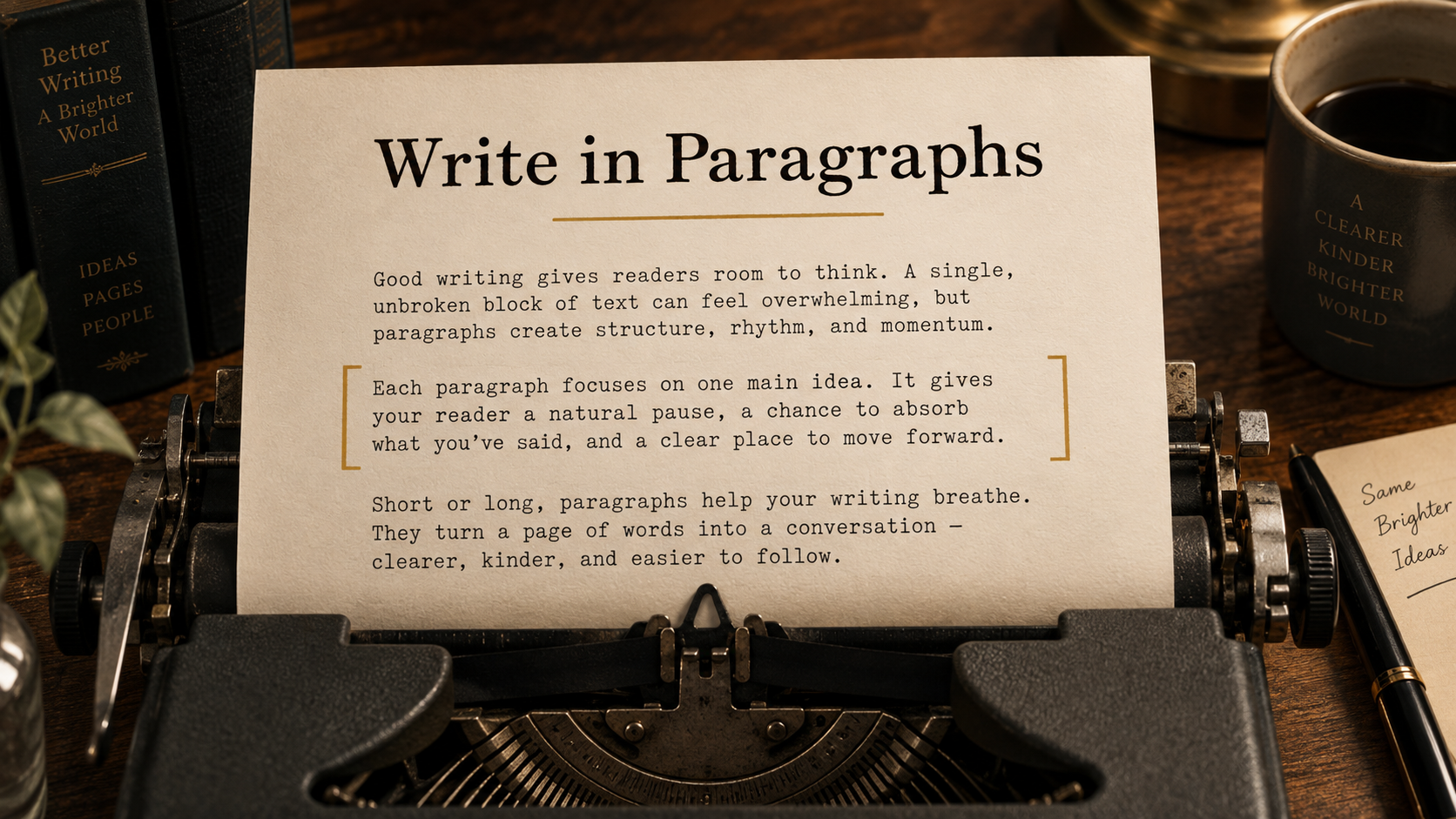
 Most people don’t read with deep concentration and attention, at least not at first. They skim. Young writers should anticipate this and tailor their writing for busy, distracted, half-interested audiences. The best formats to skim-Proof are non-urgent things we read quickly and silently, like: Work emails Memos Office reports Announcements & invitations To Skim-Proof your writing, try these four strategies: Front-load important information, ideally in your first sentence. Use bold letters and ALL CAPS to highlight key details. Indent numbered and bulleted lists to make long sentences and paragraphs easier to read. Edit out extraneous words and sentences. Don’t think of Skim Proofing as surrendering to our attention-deficit culture. Think of it as a literary deep core exercise. Because front-loading content, streamlining text, and breaking up long paragraphs will strengthen all your writing — even longer, closely read forms — over time. Until next week… keep writing!
January 23, 2026
When young writers ask, ”What should I read to improve my writing?” they usually mean, “Who?” And of course, there are plenty of great literary stylists young writers can learn and steal from. But for young writers in 2026 — betrayed by our thumbless education system and beset by screen distractions — the Who doesn’t matter as much as the When . If you really want to improve your writing, adhere to a simple rule: The majority of what you read every day should be more than 24 hours old. This is not to say good writers only read 19th century English novels or Homeric epics. There is plenty of great writing being produced right now. But it's not on Twitter. Don’t surrender your reading habits to an algorithm, especially an algorithm designed to make you awful. Read books. Read essays. Read poems. Read movie reviews. Yes, the quality of what you read matters. But what matters more is that you choose what you read and not the other way around. Until next week… keep writing!
January 16, 2026
Everyone knows the active voice is usually preferable to the passive voice. But most young writers are never taught why. Here are the two main reasons: 1. The passive voice is meandering. It tends to make sentences longer and harder to follow. Passive: The Constitution is something that should be followed by Congress. Active: Congress should follow the Constitution. These two sentences convey the same thought. But see how the first one is cumbersome, and almost condescending in its tone? Readers hate that. 2. The passive voice is slippery. Passive: That should not have happened. Active: I should not have done that. See how the second sentence there feels sincere and accountable while the first feels like a non-apology? That’s the passive voice at work. By deprioritizing — or outright eliminating — the subject of a sentence’s verb, it obscures responsibility for the sentence’s action. The passive voice isn’t evil. It just tends to make your sentences harder to read and you harder to trust. Until next week… keep writing!