Nib #37 — Don’t “Let us…”

Here’s a Nib for all you speechwriters and speech-givers out there — which is all of us at some point in our lives. Are you ready? Here it is. 


Don’t start sentences with, “Let us…”


“Let us…” is one of the speechy-est of all speechy expressions. It’s the kind of thing that sounds like the kind of thing you hear in important speeches (which is to say, John F. Kennedy used it a lot). 


But hold on, you might say! Martin Luther King, Abraham Lincoln, John Paul II, and Winston Churchill all used “Let us…” from time to time. And if it’s good enough for the greatest orators of the age, why not for everyday congressman or school board member or town hall speakers? 


First, because chances are they are not among the great orators of the age — speechy rhetoric is hard to pull off. Second, and more importantly, because “Let us…” is an assertion of deep, earned leadership and trust. It’s a rhetorical technique of speaking for rather than appealing to one’s audience. 


When Dr. King said “Let us…” to civil rights activists, his own part in that “us” was acutely, heroically authentic. And President Lincoln’s 2nd Inaugural — “let us strive on to finish the work we are in to bind up the nation's wounds” — not only spoke for the ravaged Union he represented, but conspicuously included the conquered southern states in its “us.”


Of course, there are more ways to earn trust than leading millions of people through harrowing crusades. We all know beloved institutional leaders — clerics or business executives or headmasters or coaches — who have earned it over many years of devoted, sacrificial service.


Without that kind of trust, “Let us…” comes across as presumptuous and cringe. Imagine being a lifelong employee at Apple Computers, dating back to its Golden Age, how different “Let us…” might sound coming from Steve Jobs vs. Tim Cook. Just think about how you would receive “Let us…” from a politician you dislike in behalf of a cause you oppose.


In our increasingly divided and trust-deprived culture, would-be leaders should be submitting ideas to their audience rather presuming to speak for them. 


Let us all help stop orators from claiming trust they have not earned.


Until next week… keep writing!
December 12, 2025
The corollary to last week’s Nib — Nib #100 The Magic Trick — is that in addition to reading their work out loud, writers should also read it as other people. First and foremost, they should read it aloud as their audience. Remember, everything you write is written for someone else. To write compellingly or persuasively, you have to zero in on the people you’re writing for . How old are they? How educated? Where are they from? What are their politics, religious views, or interests? When you read your work out loud, put yourself in their shoes. What do you hear? Is your word choice appropriate? Is your sentence structure clear? Will they get your references and jokes? Will they share your priors or bristle at them? Will they connect the dots you want them to, or find your logic discordant? To write effectively, you have to tailor your writing to your intended audience — whoever it is. So when you edit your work, don’t just read it out loud as yourself, valuable as that practice is. Also read it out loud as the audience — they’re the ones who really matter, after all. Until next week… keep writing!
The best writing tip the Nib -- or anyone else -- can ever give you.
December 5, 2025
Ok, here it is — for Nib #100 — the single best writing tip anyone can ever give you. If you want to improve a piece of writing — a whole draft, a paragraph, or even just a sentence — read it out loud. Human beings are hard wired for talking and listening, not writing and reading. So when you edit and revise your work, read it out loud. Your ears will hear what your eyes won’t see. You’ll hear mistakes that you’d otherwise miss. More than that, you’ll hear things that aren’t necessarily wrong, but could be better. Overlong sentences, imperfect word choices, and extraneous phrases that may look fine will — when read aloud — clang in your ears like false notes. It’s like a magic trick. Even if you’re not sure why something needs to be changed, you’ll it sounds wrong and change it. No matter how good or bad your writing is, reading it loud will help you make it better: guaranteed, and right away. Until next week… keep writing!
November 28, 2025
If you’ve ever wondered when it might be advantageous to write in the passive voice, check out President Abraham Lincoln’s first Thanksgiving Day proclamation from 1863. It’s all about the blessings that Americans — despite the horrors of the Civil War — still have to be grateful for. But notice how passively Lincoln catalogs them: “peace has been preserved with all nations” “order has been maintained” “the laws have been respected and obeyed” “harmony has prevailed” “population has steadily increased” “mines… have yielded even more abundantly” Notice what’s missing in all these passive phrases and intransitive verbs? Why, the chief executive whose deft leadership delivered this bounty to the American people! Passive writing distances actors from their actions. It helps scoundrels avoid culpability, as in, “Mistakes were made.” And it helps clever leaders insinuate their own merits without directly trumpeting them, as in, “Thank heavens our nation has been so uncommonly prosperous, respected, and happy during my presidency.” That is what the passive voice can be good for: blame avoidance and humblebragging. Until next week… keep writing!
November 21, 2025
There are no great films about writing. It’s understandable. Writing isn’t very cinematic. So movies “about writing” tend to glaze the grind in sentimentality (like Finding Forester ) or hide it in weirdness (like Adaptation ). But we don’t actually need a great movie about writing. Because there is one great movie scene that covers the subject. A few minutes into A River Runs Through It , we get a 90-second vignette of future author Norman Maclean learning how to write under his minister father’s tutelage. It’s the best:
Zoomer writers didn’t fail. We failed them.
November 14, 2025
When it comes to reading and writing, the kids aren’t alright. According to a viral essay last spring, “The Average College Student Is Illiterate." And it’s not just anecdata. A 2024 study found a majority of English majors could not understand the first seven paragraphs of Charles Dickens’ Bleak House . A record low 35 percent of last year’s high school seniors (today’s college freshmen) read at grade proficiency. On the other hand, U.S. students’ writing has gotten so bad the government stopped testing it. The almost unthinkable truth is that most of Gen Z is functionally illiterate. There’s a lot to say about all this. But the first thing is: it’s not their fault. It’s ours. It’s adults’ responsibility to teach children how to read and write. For a long time now, society has shirked that responsibility. We’re the ones who gave kids phones, tolerated their overuse, and let schools get away with not teaching them.  Gen Z didn’t fail. We failed them. But the Nib always looks for the sunny side of the data. And in this case, it’s right there for any student or young professional to see. Here are two, potentially career-making facts hidden in the dysfunction: 1. In a low-literacy labor market, people who can read and write will possess a rare and lucrative skill. 2. Just a little bit of practice — as little as 30 minutes of thoughtful reading and writing a day — can turn any Zoomer into a comparative Homer among his peers. There is still plenty of time for students and young professionals to turn their generational betrayal into an opportunity. The handful of Zoomers who don’t need ChatGPT to write for them are going to own the future. Until next week… keep writing!
November 7, 2025
One of the challenges young writers today face when trying to improve their craft is they don’t know quite what to aim for. They may know good writing when they read it. But schools nowadays rarely teach students what makes a piece of writing good. So most young writers are left to figure it out on their own. But they don’t have to! About a century ago, the Kansas City Star newspaper tried to solve this problem by laying out 110 rules to guide its reporters’ writing. One of those reporters was young Ernest Hemingway, who ever after credited his spare, clean style with his old boss’s rules. “Use short sentences. Use short first paragraphs. Use vigorous English. Be positive, not negative.” What’s not to love?! If you’ve ever just wanted all the rules of good writing on one sheet of paper you can pin up on a bulletin board above your desk, here you go :
October 31, 2025
Senate Republican Leader John Thune gave the most memorable speech of his long congressional career this week when he blew up at Democrats over the ongoing government shutdown: “SNAP recipients shouldn’t go without food. People should be getting paid in this country. And we’ve tried to do that 13 times! You voted no 13 times! This isn’t a political game. These are real people’s lives that we’re talking about. And you all just figured out, 29 days in, that oh, there might be some consequences?” It was the first time most Americans have ever heard Thune raise his voice. Indeed, it’s the first time the Nib can remember the famously unflappable Thune so nearly flapped!
October 24, 2025
Okay, you’ve targeted your audience, mapped out an outline, vomited up a terrible first draft, and now you’ve edited and revised it once. Now what? The first answer is, “Edit and revise it again, at least once more.” (Writers should not voluntarily hand in anything rougher than a third draft — see Nib #86 .) On the other hand hand, you can’t rewrite forever. At some point, writing projects have to be put to bed. So the question remains: in the absence of a pressing deadline, how can writers know when they reach that point? How do you know you’re done done? The best answer is, when you feel yourself nitpicking . The first round of edits is for out-and-out mistakes. The second is for big refinements — breaking up long sentences, streamlining repetitive points, deleting digressions. After draft three, your edits will get more granular: eliminating unnecessary words, condensing overlong clauses and phrases, correcting personal tics, and tightening up word choices. Somewhere after draft four, your edits will become less obvious and less clarifying. Some of them will help with flow or tone. You may even stumble onto a gem of a new thought. But at a certain point, the changes will start to feel almost arbitrary — whether to put a subordinate clause before or after the independent clause, whether to turn a certain comma into an em dash, whether to change a “President Trump” into “Trump” or “the Administration.” When changes to the text stop clarifying its meaning, you’re no longer editing. You’re nitpicking. And when you feel yourself nitpicking, it’s time to stop. It may come on your fifth draft. It may come on your 20th. It’s not about the number. It’s about the feel. It’s about the moment when you’re reading your work and you can’t really tell the difference between this draft and the last one — when tweaks start to feel like they are coming from you rather than from the text itself. When you can’t tell if your changes are making the writing better or worse: that’s when you know you’re done. Until next week… keep writing!
October 17, 2025
“Show, don’t tell” may be the #1 piece advice in creative writing. It urges authors and poets and even journalists to put their readers in a scene, in a moment, in an image, rather than simply describing it. It’s good advice — and just as applicable to persuasive writing. Consider the following telling sentences, of the sort written every day in Washington op-eds, speeches, constituent letters, etc. Immigration is a crucial issue to America. These budget cuts will hurt the most vulnerable. The economy needs pro-growth tax cuts. The problem with these telling sentences is that they assert conclusions instead of presenting evidence. They raise questions rather than answer them. Why is immigration crucial? How will the budget cuts hurt people? What will pro-growth policies do for the economy? If we rework those sentences to focus on evidence instead of unearned conclusions, they become more interesting, vivid, and persuasive: Joe Biden’s open borders policy reduced blue collar wages by 4%, added $61 billion to the budget deficit, and enabled drug cartels to smuggle enough fentanyl into the country to kill every American citizen. Under these budget cuts, a single Ohio mom with three kids would lose her health insurance, child care, and her second job. If we lower income and capital gains tax rates today, Colorado alone will see 3,200 new business startups and 20,000 new jobs in the next 12 months. Persuasion is not about telling people how they should think about an issue. It’s about showing them the issue — the problems, proposals, and tradeoffs — in such a way that they reach the conclusion you want them to reach. Whatever your evidence — statistics, stories, analogies, images — don’t describe them. Don’t explain how people should feel about the evidence. Instead, present the evidence, as clearly and concretely as possible. Do that, and the persuasion will take care of itself. Until next week… keep writing!
October 10, 2025
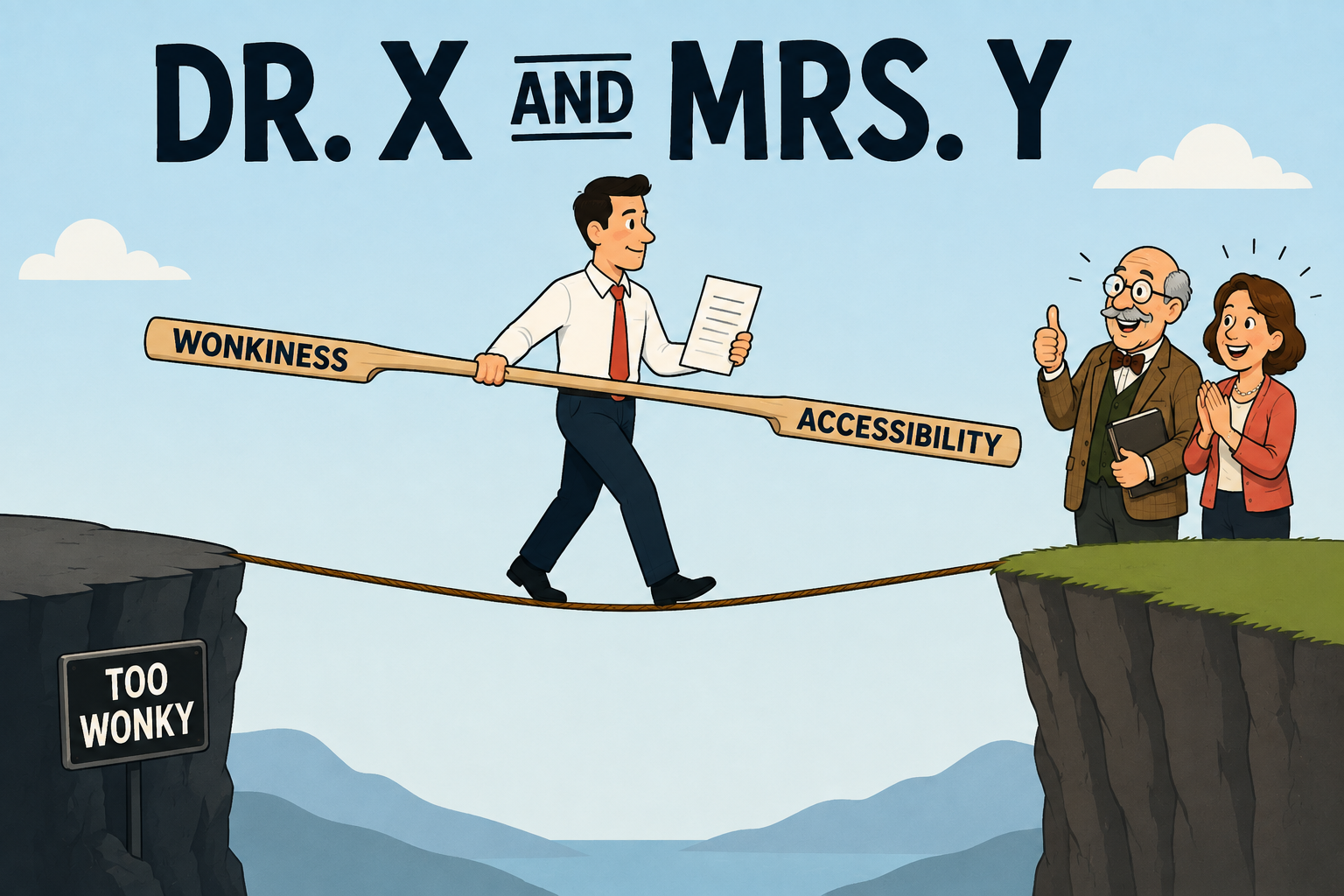
This week, a little trick for all the speechwriters out there working with dense, wonky policy minutiae (and bosses who love it). Turning complex ideas and obscure data into compelling stories and arguments is very often what speechwriting is . That’s why even the most abstruse technocratic debates, when introduced to a general audience, can quickly devolve into blistering morality plays. Sometimes, though, certain details are too essential to an argument to be dumbed down or moralized. They must be presented in all their dry, impenetrable specificity. The problem here is not just that obscure facts can be boring, but that using them risks alienating one’s audience — making the speaker seem pretentious, talking down to the less informed. One way speechwriters skin this cat is with the phrase, “As you know…”, like this: “As you may know, violent crime in the county fell by 22 percent over the last six months.” Or: “As many of you know firsthand, Ireland is America’s top pharmaceuticals trading partner.” Prefacing information that the audience probably doesn’t know with the suggestion that they might can soften its reception. It invites the audience into the argument, making inclusive points that might otherwise be alienating. Ronald Reagan used it: "And as you may know, I approved raising the ceiling so they can buy an additional 10 million metric tons in the next year.” So did John F. Kennedy : "As you may know, there is currently a dispute over whether the Administration should spend the additional defense funds voted by the last Congress.” And Franklin Roosevelt : “[A]s you know, we have put 300,000 young men into practical and useful work in our forests and to prevent flood and soil erosion.” Of course, “As you know” does not give a speechwriter license to lard up rhetoric with unnecessary wonkery. It’s just a little sugar you can sprinkle on necessary details every once in a while to help them go down easier. Until next week… keep writing!