Nib #94 How to Know When You're Done

Okay, you’ve targeted your audience, mapped out an outline, vomited up a terrible first draft, and now you’ve edited and revised it once. Now what?


The first answer is, “Edit and revise it again, at least once more.” (Writers should not voluntarily hand in anything rougher than a third draft — see Nib #86.)


On the other hand hand, you can’t rewrite forever. At some point, writing projects have to be put to bed. So the question remains: in the absence of a pressing deadline, how can writers know when they reach that point? 


How do you know you’re done done? The best answer is, when you feel yourself nitpicking


The first round of edits is for out-and-out mistakes. The second is for big refinements — breaking up long sentences, streamlining repetitive points, deleting digressions. After draft three, your edits will get more granular: eliminating unnecessary words, condensing overlong clauses and phrases, correcting personal tics, and tightening up word choices.


Somewhere after draft four, your edits will become less obvious and less clarifying. Some of them will help with flow or tone. You may even stumble onto a gem of a new thought. But at a certain point, the changes will start to feel almost arbitrary — whether to put a subordinate clause before or after the independent clause, whether to turn a certain comma into an em dash, whether to change a “President Trump” into “Trump” or “the Administration.”


When changes to the text stop clarifying its meaning, you’re no longer editing. You’re nitpicking. And when you feel yourself nitpicking, it’s time to stop. It may come on your fifth draft. It may come on your 20th. It’s not about the number. It’s about the feel. It’s about the moment when you’re reading your work and you can’t really tell the difference between this draft and the last one — when tweaks start to feel like they are coming from you rather than from the text itself.


When you can’t tell if your changes are making the writing better or worse: that’s when you know you’re done.


Until next week… keep writing!
July 31, 2026
Smart writers have a weakness for overcomplicated sentences. The more ideas a writer can hold in his head, the harder it can be to present them in a reader-friendly way. If you ever find yourself writing or editing a sentence that feels overstuffed, stop and ask yourself, What is this sentence’s job? Most sentences perform one of three tasks: Saying what something is or is not. Saying what something is or is not like. Saying what something caused or was caused by. Once you decide which job the sentence needs to do, rewrite it as a simple independent clause doing that job and nothing else. Add back only what is necessary to express that one thought. Leave the next thought for the next sentence. If you’re having trouble connecting all your dots in one sentence, use two or three. Your readers will appreciate it. Until next week… keep writing!
July 24, 2026
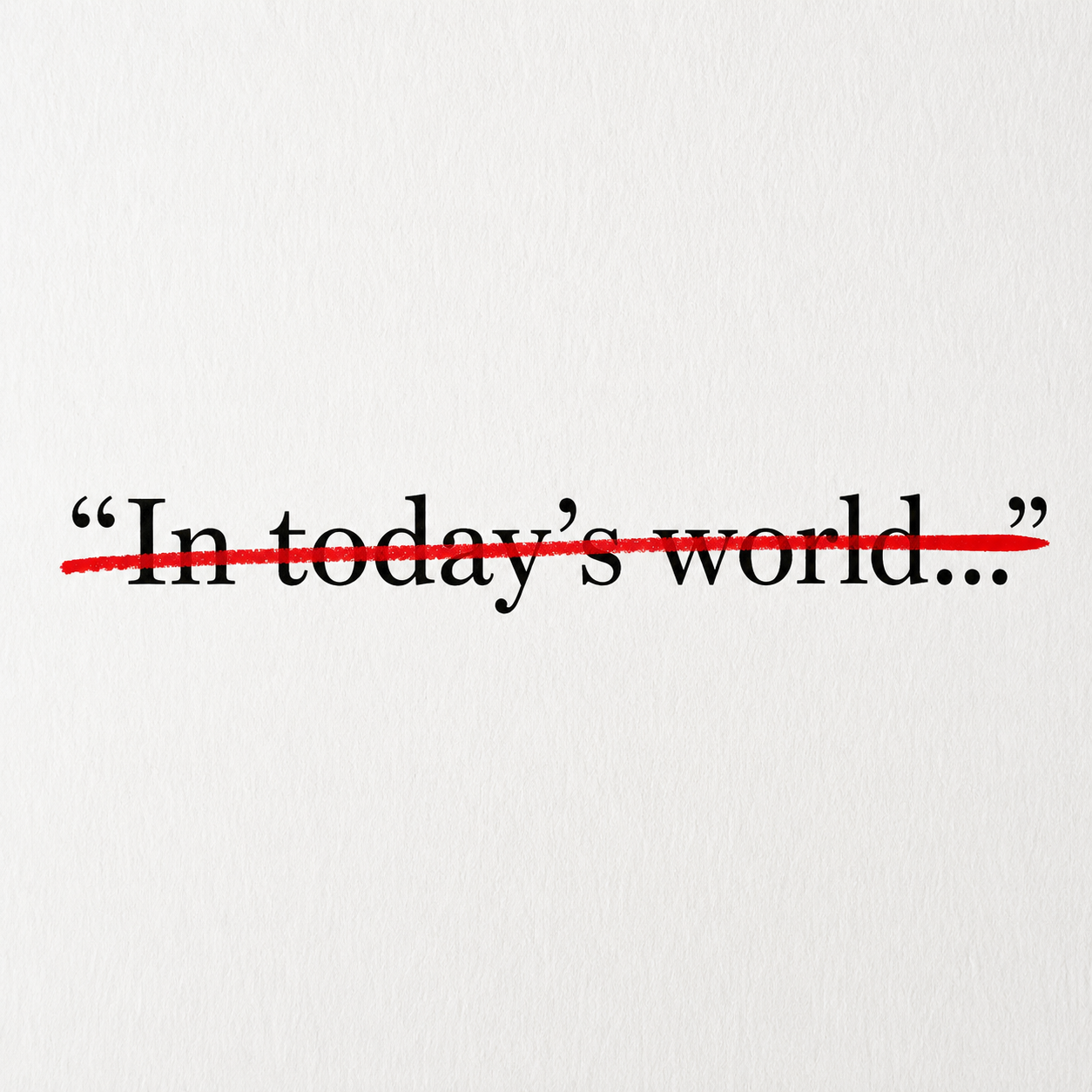
This week, another addition to the Nib’s list of phrases writers should always delete from their work: “In today’s world…” First of all, it’s just a longer way of saying “today” or “nowadays” or “these days.” And writers should always look to trim extraneous words.  Second, the phrase is clunky. No confident human being in relaxed conversation ever says “in today’s world.” It’s the kind of thing we write when we are insecure and trying to fake it. Be confident. Be relaxed. Don’t let “in today’s world…” survive past your first draft. Until next week… keep writing!
July 17, 2026
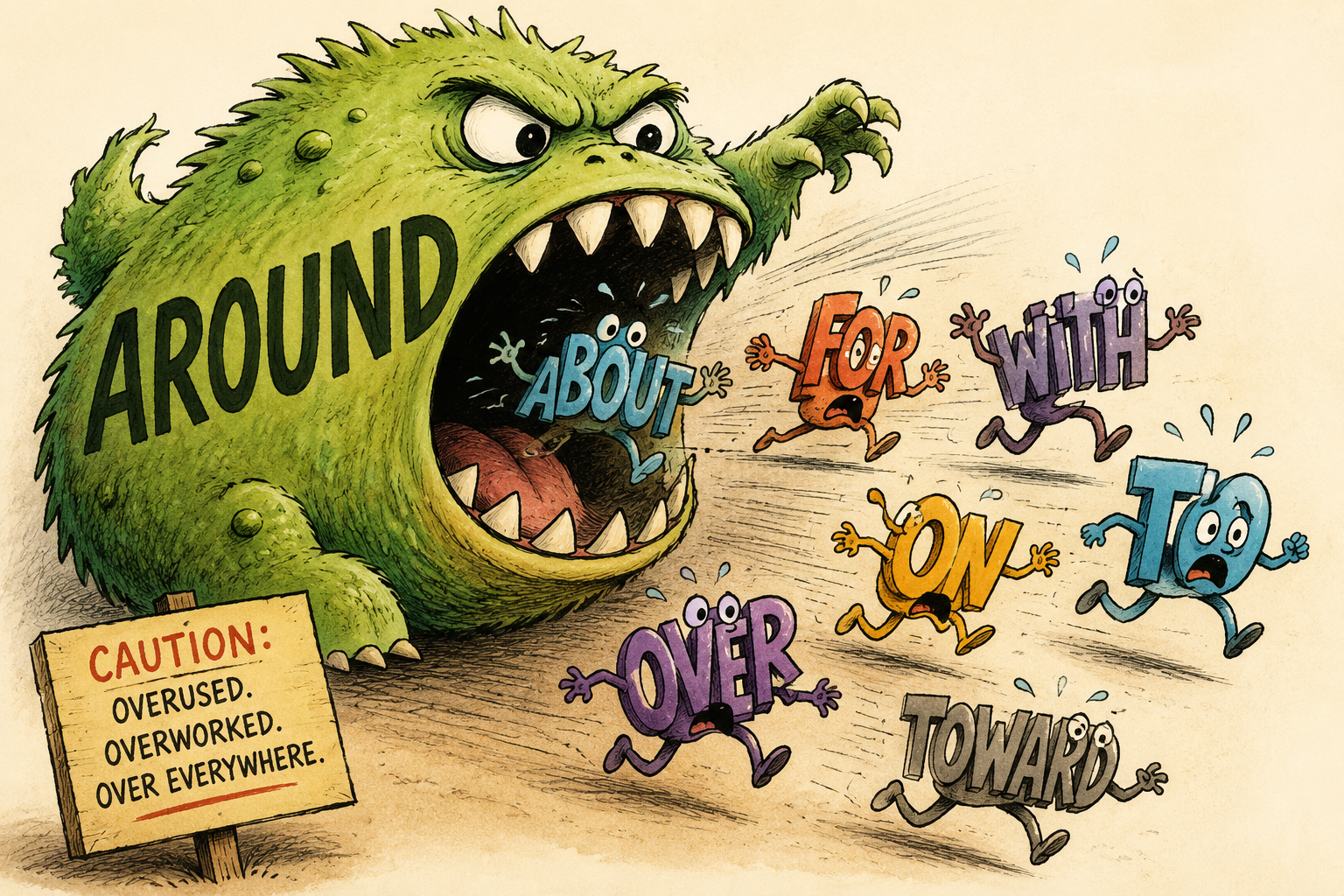
At some point in the last two decades, around became the monster that ate the other prepositions. Every day we read of “debates around immigration” and “plans around the weekend” and “coordination around fundraising.” Good writers have to fight back. Around is a perfectly good word. But it means around. It does not mean about , regarding , for , toward , with , over , on , or to . The problem isn’t grammar; it’s clarity. When one word tries to do the work of half a dozen others, communication breaks down. Writing gets sloppy and readers get confused. Luckily, there’s an easy fix. Young writers who grew up amidst the Great Aroundening should make around a yellow-flag word, like that or issue . Every time you read it in your own work, pause and ask whether another preposition would better capture the relationship you're trying to describe. Prepositional precision may seem like nitpicking. It’s not. It can mean the difference between a clear sentence and a fuzzy one, a fluid paragraph and a clanging one, and a writing sample that earns an interview instead of a rejection. Always go the extra mile for your readers, not around them. Until next week… keep writing!
July 10, 2026
The trick to persuasive writing is that you have to change readers’ minds without putting them on the defensive for not agreeing with you in the first place. A great way to make arguments more palatable without watering them down is by using five humble but rhetorically powerful words: “It seems to me that…” Consider these three claims: City life is better than country life. Tax cuts boost economic growth. Yogi Berra was better than Johnny Bench. Now compare them to these: It seems to me that city life is better than country life. It seems to me that tax cuts boost economic growth. It seems to me that Yogi Berra was better than Johnny Bench. The assertions remain the same. But see how open and gracious the sentences become? Now imagine you prefaced each with a fact or two backing up the claim. All of a sudden, you have a confident, forceful argument that nonetheless draws your audience in by proposing rather than imposing your conclusion. When backed by evidence, humility and generosity are much more persuasive than swagger. “It seems to me that…” invites your audience to agree with you, which is the surest way to get them to yes. Until next week… keep writing!
July 2, 2026
Tomorrow Americans will celebrate Thomas Jefferson’s best piece of writing. Today, though, the Nib tips its cap to what may be Jefferson’s second-best line: a bit of writing advice, of all things. “The most valuable of all talents,” the Sage of Monticello said, “is that of never using two words when one will do.” He’s not wrong. Concision ( Nib #48 ) has distinguished good writing for far more than 250 years. It simultaneously signals humility and confidence, intelligence and generosity. It makes sentences clearer, easier to read, and much more persuasive. Indeed, as Jefferson himself proved, clear and concise writing can change the world. Until next week… keep writing!
June 26, 2026
Most writing advice has caveats. Even words like significantly and whomsoever have their place. But some words and phrases you really can just delete every time you see them in your drafts. Here are three: 1. “In order to…” 2. “The fact that…” 3. “It should be noted that…” These phrases are pure clutter. Instead of “in order to…” just say “to.” Instead of “the fact that…” try “that.” Or better yet, rework the sentence. It’s clunky. And instead of writing “it should be noted that…” just skip to the noting itself. (So “It should be noted that the stock price remains high” becomes “The stock price remains high.” ) We all write these phrases from time to time. The important thing is that when you come across them, don’t try to edit them. Don’t massage them. Just cut them. We don’t negotiate with terrorists. Until next week… keep writing!
June 19, 2026
Apostrophes are like deodorant or salt: people only notice if you use them wrong. So here is a quick Nib refresher. Apostrophes have three uses:  1. To indicate possession — as in “Bob’s haircut” or “Ted Williams’s bat.” 2. To make contractions, like “can’t” from “cannot.” (And remember, it’s always a contraction for “it is,” as opposed to the un-apostrophed possessive pronoun its .) 3. To pluralize individual letters, as in, “Sally got straight A’s” or “Mind your p’s and q’s.” Apostrophes do not make words plural. So it’s the 1980s , not the 1980’s. It’s a collection of CDs and DVDs , not CD’s and DVD’s . And it’s “keeping up with the Joneses,” not “the Jones’s.” No one will ever think you’re smart because you use apostrophes correctly. But if your résumé includes lines like managed intern’s or drafted constituent letters’ don’t be surprised if you don’t get called in for interview's. Until next week… keep writing!
June 12, 2026
There is nothing wrong with “to be” verbs — is , are , were , was , am , etc. Sometimes they’re the right word (like in this sentence!). But often “to be” verbs hide the right word. Consider: The Senator is a supporter of gun control. The storms were responsible for the delayed flights. In each case, an action verb can convey the same thought in a tighter, livelier sentence, like: The Senator supports gun control. The storms delayed the flights. Active verbs give your nouns something to do. And when your nouns move, so does your writing. So next time you’re editing something you wrote, circle every “to be” verb and then re-read the sentence. See if there is an active verb in the second half of the sentence masquerading as a noun or an adjective, like in the examples above. If swapping that verb in for the “to be” one makes the sentence brisker and more vivid, congratulations: you just learned a way to improve every paragraph you ever write. Until next week… keep writing!

June 5, 2026
For all the rules against using AI in your writing, there is one way all young writers should be using it: finding typos. AI apps are excellent at identifying the kind of mistakes that our eyes might overlook. Think misspelled or repeated words, doubled-up prepositions, that kind of thing. Writers get worse at finding these things after a few reads because familiarity with the text dulls our proofreading eyes. So when you have edited something yourself a few times already, have AI scrub it -- not for content, just for typos. Never have the app make the changes for you. Tell it to give you a list of typos it found, and then enter the changes yourself. That way you will always hold pen and own every correction yourself. Until next week… keep writing!
May 29, 2026
Reading is hard enough when words’ meanings are fixed. When they are fluid, it’s like trying to play catch in the dark. Young writers who want to join the rearguard fight for clarity against confusion can start with these five words that almost everyone misuses these days: 1. Enormity means terrible sin, not scope. So don’t refer to the “enormity of America’s victory in the Cold War” unless you’re a communist. 2. Unique means one of a kind, not rare. Never say “pretty unique” or “very unique.” Something is either unique or it’s not. 3. Nauseous describes things that make one nauseated ; it doesn’t mean sick at the stomach. As Strunk & White put it, “Do not, therefore, say, ‘I feel nauseous,’ unless you are certain you have that effect on others.” 4. Disinterested means impartial, like a judge. Uninterested means indifferent to, like the way people feel about professional lacrosse. 5. Finally, to imply means to hint at or suggest something as a writer or speaker. To infer means to conclude, as a reader or listener, what a writer or speaker might be implying. Always remember, precision in writing isn’t about pedantry; it’s about generosity toward one’s readers. Until next week… keep writing.